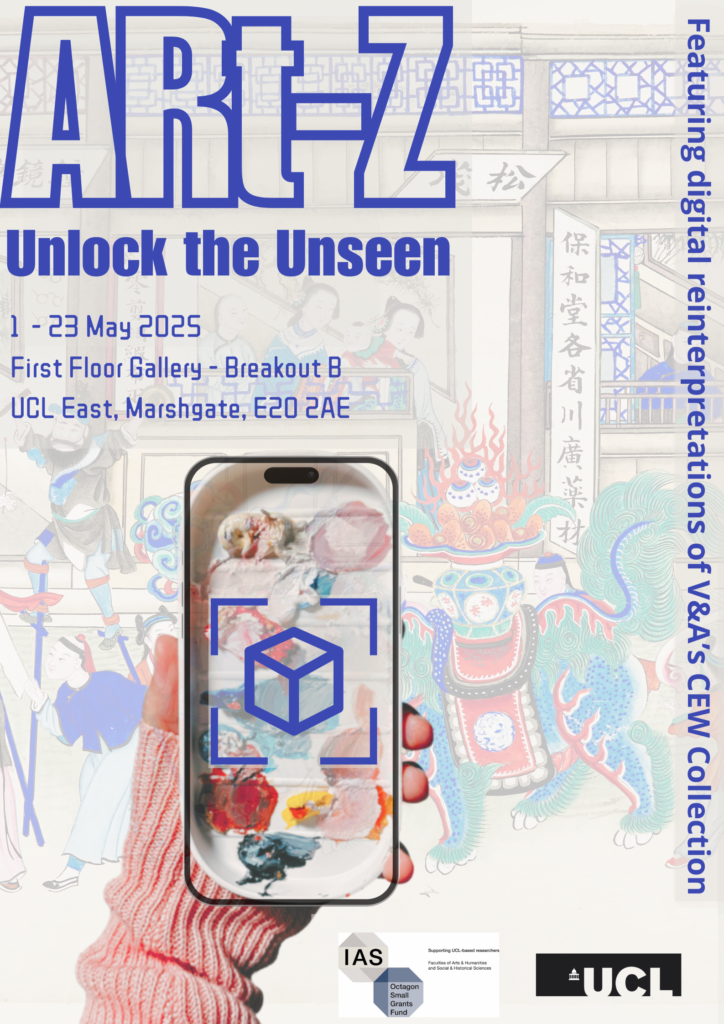
The ACN – Europe online workshop held on 28 November 2025 and chaired by Dr Rosalien van der Poel, specialist in Chinese export art and a member of ACN – Europe’s scientific committee, focused on a presentation by Zeyu Zhao, PhD student in the Department of Information Studies at UCL, about an augmented reality (AR) exhibition featuring Chinese export watercolours, which stemmed from her ongoing doctoral research.
The research-led mini-AR exhibition “ARt-Z: Unlock the Unseen” featuring Chinese Export Watercolours from the V&A collection, explored how AR can engage younger audiences with historical artworks. As it is explained in a UCL blog about this pilot study in creative digital engagement with museum collections, Chinese export watercolours were “created by professional Chinese artists in the eighteenth and nineteenth centuries for European and North American markets. These works, which blend Chinese and Western artistic techniques, present local customs, occupations, trades, flora, fauna, and cultural beliefs. Despite their historical significance, they remain relatively understudied. Their transcultural nature and unfamiliarity to most audiences made them ideal objects for AR reinterpretation.” (https://blogs.ucl.ac.uk/che/2025/07/14/a-pilot-study-in-creative-digital-engagement-with-museum-collections/)
The exhibition, held at UCL East campus, presented 10 digitised paintings enhanced with AR elements, allowing visitors to uncover hidden details and interact with animations. The selection of watercolours was dictated by their strong storytelling quality, their cultural representativeness, their potential to encourage emotional engagement and their visual richness. For instance, the image of a procession, presenting a scene of social interaction, was included for its liveliness and vibrancy, for the emphasis on the aspect of communality in Chinese culture and for the possibility to apply different layers of interpretation and animation. Zeyu Zhao explained the technical implementation using Adobe Aero and shared observations of visitor engagement. It emerged that many visitors were attracted to the exhibition because they had learned about it from shared posts on social media, with some returning multiple times. Visitors spent a long time interacting digitally with the images and were able to create a simple animation in about 15 minutes. Over 96% of the feedback was positive and some made suggestions for improvements, such as the production of a brochure or the enhancement of the experience with transitions from one painting to another.
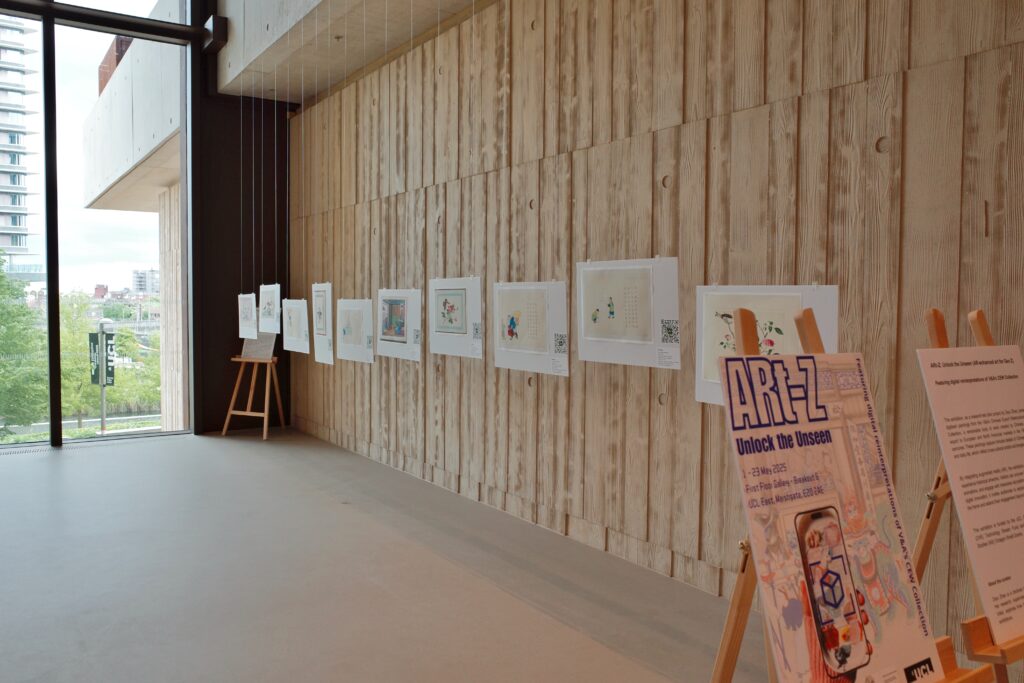
To sum up, this exhibition can be seen as an experiment exploring how new technologies can be beneficial to achieve the following goals:
– to make cultural heritage accessible to younger generations
– to create meaningful cultural encounters
– to merge traditional arts with digital literacies
– to engage visitors not just as consumers but also as creators.
Dr Jin Gao, Lecturer in Digital Archives at the UCL Department of Information Studies, explained that this research is part of project on Chinese Export Watercolours, in collaboration with the V&A Museum, aiming to use digital humanities methods to analyse this type of painting on a large scale. It was explained that the project has three phases: cataloguing and digitisation; provenance research using digital tools to trace similarities between paintings and investigate authorship; examining the use of AR technology to engage young audiences at UCL with Chinese paintings.
Dr Jin Gao presented an overview of a project involving the digitisation and analysis of the V&A’s Chinese painting collection, which began in 2023. The project involved 11 UCL Digital Humanities master’s students who catalogued, photographed, and classified 2,352 paintings. The research revealed that 74% of the paintings were purchased, 18% were of unknown origin, and 8% were gifts, with acquisitions spanning 150 years from 1871. Digital methods were used to analyse similarities and differences in themes across the collection, showing a significant shift in Western consumers’ interest from diverse Chinese cultural themes before 1840 to a focus on occupations and trades afterward. The analysis also showed a stylistic shift from more detailed and artistically careful depictions (in 18th– and early- 19th-century watercolours) to less accurate and more graphically simplified representations (in watercolours produced from the middle of the 19th century to early 20th century).
A new fourth phase involving collaborations with UK museums and an AHRC Knowledge Exchange grant for building a platform to map CEW collections across institutions is now underway.
More information about the project can be found at:
https://www.dhi.ac.uk/dhc/2024/paper/253
https://discovery.ucl.ac.uk/id/eprint/10206985/1/CEW_DHI_2024.pdf
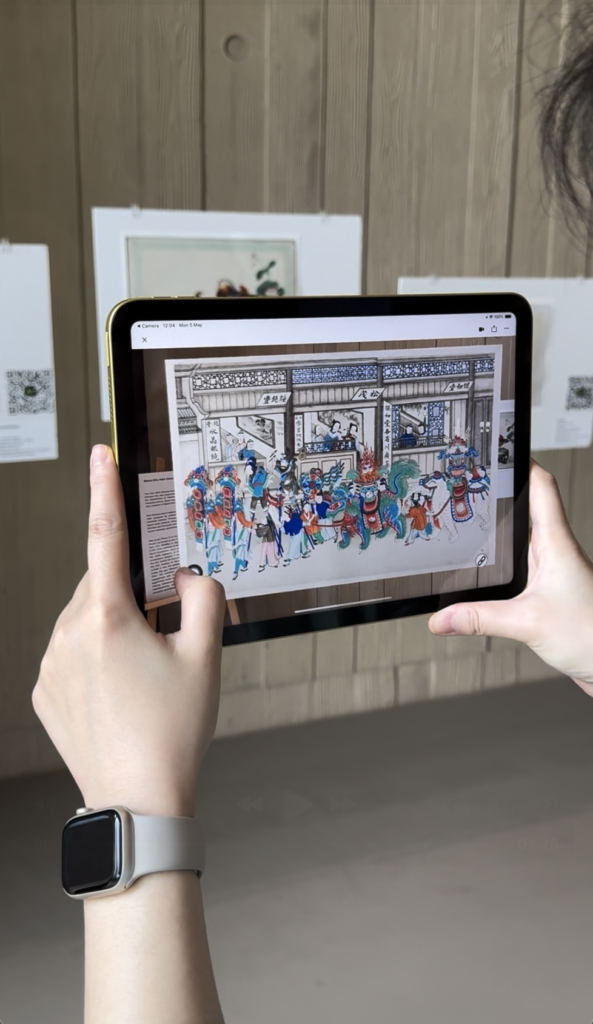
Zeyu Zhao demonstrated how the AR technology brings historical Chinese paintings to life through interactive animations and sound effects, with historical accuracy being a key consideration. The discussion explored the potential of AR technology for museum displays highlighting the importance of collaboration between technical experts and art historians to create accurate and engaging museum experiences, particularly to attract younger audiences.
[© All images courtesy of UCL (University College London)]